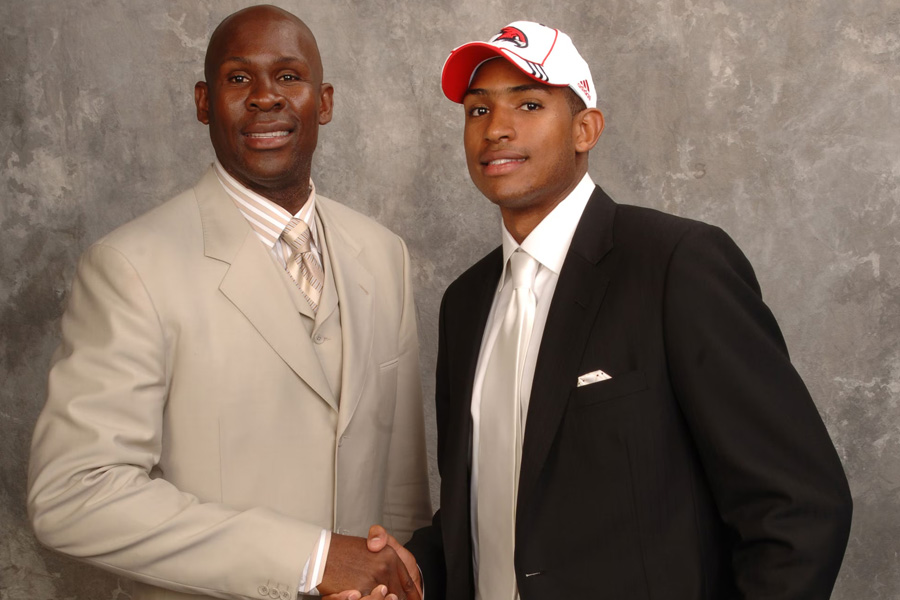
Alfredo William “Tito” Horford’s legacy extends beyond his brief NBA career. Horford, born in La Romana, Dominican Republic, on January 19, 1966, was the first Dominican NBA player. His route was unusual. It brought him from baseball grounds and a remarkable teenage growth spurt to American high school basketball, a complicated college recruiting odyssey, the NBA, professional leagues worldwide, and a family-centered life.
What strikes me about Tito Horford’s narrative is how many chapters fit into one life. He was a premature child nicknamed “Tito” for his small size at birth, a teenage baseball prospect who became a towering basketball center, a highly recruited college player caught in NCAA controversy, and the father of Al Horford, one of the most accomplished Dominican NBA players.
Tito Horford’s Early Life in the Dominican Republic
Tito was born approximately two months premature, during the seventh month of his mother’s pregnancy. His mother, Ana Graciela Baltazar, raised seven children in a modest Dominican household. His father, a Bahamian immigrant often identified in accounts as William Horford, introduced Tito to English while he was young.
The family spent part of its life in San Pedro de Macorís, an area deeply associated with baseball. That environment naturally shaped Tito’s earliest athletic ambitions. As a boy, he showed promise as a baseball pitcher and initially imagined a future on the diamond.
Then his body changed dramatically.
By about age 15, Tito had grown to approximately 6 feet 10 inches. His height was becoming an obstacle for pitching, but it was an extraordinary advantage for basketball. He made the switch, and the sport that initially seemed like an alternative quickly became his calling.
He played basketball in the Dominican Republic, including with Club Naco in Santo Domingo, before moving to Houston, Texas, around 1982. His American high school career transformed him from a talented Dominican teenager into one of the most coveted centers in the country.
Marian Christian Turned Tito Into a National Prospect
At Marian Christian High School in Houston, Tito developed rapidly under coach Bob Gallagher. His size, rebounding ability, and shot blocking made him a formidable presence.
As a senior, he reportedly averaged approximately 18 points, 12 rebounds, and 6 blocks per game. Those numbers helped establish him as one of the country’s premier high school centers.
His accomplishments included McDonald’s All American recognition, first team Parade All American honors, Texas high school player of the year recognition, and three consecutive private school state championships.
The attention brought opportunity, but it also brought complications.
Tito’s college recruitment became one of the most complicated episodes of his young career. Multiple universities wanted him, while coaches, intermediaries, family members, lawyers, and NCAA investigators became involved. What should have been a straightforward transition from high school to college basketball became a maze.
The Recruiting Saga That Followed Tito Horford
Houston appeared to have the early advantage. In 1984, assistant coach Donnie Schverak traveled to the Dominican Republic during a period when NCAA recruiting restrictions applied. Transportation and contact provided during the visit became part of the violations that ultimately affected Tito’s eligibility.
Horford signed with Houston in November 1984, with Gallagher involved in the paperwork as his guardian. The NCAA eventually ruled him ineligible to play for Houston because of recruiting violations. Houston challenged the decision, but the appeals were unsuccessful.
The situation became even more complicated when allegations emerged concerning possible benefits involving Tito’s family and people around him. Claims included assistance involving travel, employment, housing, and other forms of support. Some of those allegations were denied, and not every claim was ultimately sustained.
The Houston chapter closed, but Tito’s recruiting problems were only beginning.
LSU Became the Next Complicated Chapter
In August 1985, Tito enrolled at Louisiana State University under coach Dale Brown. LSU had existing connections to Dominican basketball, making the school an appealing destination.
But the NCAA investigation followed him.
Questions arose about Dominican basketball figure Eduardo Gómez and whether improper benefits had been offered to Tito’s family. The allegations included food, medicine, money, housing, employment, and other assistance. Gómez denied the accusations, while LSU disputed many of the claims.
Tito eventually spoke with an NCAA investigator. Soon afterward, his relationship with LSU deteriorated.
In early November 1985, he missed practice and an intrasquad scrimmage. Brown suspended him and subsequently dismissed him from the team. The coach publicly raised concerns about interference from other programs and passed information to investigators.
For a teenager who had recently arrived from the Dominican Republic and was still adapting to American basketball and culture, the experience was extraordinarily complicated.
A Young Player Caught Between Programs
After leaving LSU, Tito’s college future became uncertain. He considered professional basketball overseas and explored several other American universities.
Programs such as UCLA, Kentucky, and Louisville became associated with the recruiting discussions, but the controversy surrounding Horford made schools cautious. Some coaches reportedly viewed the entire situation as an administrative nightmare.
What makes this period particularly striking is that Tito was still a very young athlete. His basketball talent was enormous, but his recruitment had become larger than basketball itself. Lawyers, eligibility questions, investigators, coaches, family members, and competing programs all had a stake in where he would play.
Eventually, Miami offered a path forward.
Miami Gave Tito Horford a Fresh Start
In January 1986, Tito enrolled at the University of Miami. The school offered several attractions, including its warm climate, large Spanish speaking population, and geographic and cultural closeness to the Dominican Republic.
He had to sit out part of his first season because of transfer rules, but he eventually became eligible to play.
From 1986 through 1988, Horford established himself as an important Miami center. He averaged approximately 14.2 points and 9.3 rebounds per game across his college career, while also contributing with his rebounding and shot blocking.
Miami gave him something the earlier chapters had not: stability.
After two seasons, Tito declared for the NBA draft.
Tito Horford Makes NBA History
The Milwaukee Bucks selected Horford with the 39th overall pick in the second round of the 1988 NBA Draft.
When he made his NBA debut in November 1988, he became the first Dominican born player to appear in the league.
His NBA career was modest statistically. He played parts of three seasons, including time with the Milwaukee Bucks and a later brief stint with the Washington Bullets. He appeared in approximately 63 NBA games and averaged around 1.5 points and 1.3 rebounds in roughly 6 minutes per game.
Those numbers do not tell the full story.
For Dominican basketball, his presence mattered enormously. Before Tito, there was no Dominican born player who had broken through onto an NBA roster. His achievement created a historical bridge that later players could cross.
And perhaps the most remarkable part of that bridge was waiting in his own family.
Arelis Reynoso and the Early Life of Al Horford
Tito’s first wife and longtime partner was Arelis Reynoso, a sports journalist who became the mother of his eldest son, Al Horford.
Alfred Joel Horford Reynoso was born on June 3, 1986, in Puerto Plata, Dominican Republic. His parents divorced in 1989, when Al was approximately three years old.
Arelis played an important role in Al’s early upbringing. After the divorce, Al spent much of his childhood in the Dominican Republic before moving to Michigan at around age 14 to live with his father.
That transition connected two very different worlds. Al had grown up with Dominican culture and family traditions, while Tito’s basketball journey had already connected the family to the United States.
Al eventually attended Grand Ledge High School in Michigan and became a major college prospect. At the University of Florida, he helped the Gators win two NCAA championships.
The son had inherited more than his father’s height and basketball instincts. He had inherited a story.
Tito Horford’s Second Family in Michigan
After his divorce from Arelis Reynoso, Tito remarried. His second wife is commonly identified as Elizabeth Horford, and the couple established their family around the Lansing, Michigan, area.
Together they had four children, creating a large basketball oriented household.
The family did not simply revolve around Al’s NBA career. Several of Tito’s children developed their own connections to basketball, business, music, photography, and professional life.
| Family Member | Relationship to Tito | Known Background |
|---|---|---|
| Ana Graciela Baltazar | Mother | Raised seven children in the Dominican Republic |
| Arelis Reynoso | First wife | Sports journalist and mother of Al Horford |
| Al Horford | Son | NBA champion, five time All Star |
| Jon Horford | Son | College basketball player, businessman |
| Josh Horford | Son | Basketball player and music and clothing entrepreneur |
| Anna Horford | Daughter | Former basketball player and wealth management professional |
| Maria Horford | Daughter | Photographer and former youth basketball player |
| Maíra Horford | Daughter | Professional women’s basketball player |
Jon Horford Followed His Father’s Basketball Path
Jonathon Kelly Horford, born October 16, 1991, became another basketball player in the family.
Jon played college basketball at Michigan before transferring to Florida, following a path that mirrored his older brother’s connection to the Gators.
He later had limited professional basketball opportunities, including involvement with the NBA developmental system and a short association with the Milwaukee Bucks.
Jon eventually expanded his interests beyond basketball. He pursued business, earned a master’s degree, and became involved in Michigan community and political life. His career illustrates how the Horford family story extends beyond professional sports.
Josh, Anna, Maria, and Maíra Horford
Basketball player Josh Horford attended Lansing Community College. He later became interested in music production and apparel.
A knee ailment sidelined Anna Horford from basketball. She became a wealth manager and has spoken about her family and brother Al.
Maria Horford created differently. Her childhood basketball career led her to photography in Michigan.
Maíra Horford is another basketball heir to the family legacy. She played professional women’s basketball in Brazil for Unimed Campinas after being born August 23, 1995.
Basketball is rarely woven across numerous generations and siblings, but the Horford family has made it a family language.
Tito Horford’s Life After Professional Basketball
Tito’s playing career extended far beyond the NBA.
He competed professionally in Spain, France, Italy, Venezuela, Brazil, Mexico, and the Dominican Republic. He also played extensively in Dominican leagues, including for teams such as Los Prados and San Carlos, and represented the Dominican national team.
His professional basketball journey therefore lasted roughly from 1988 into the early 2000s.
After basketball, Tito settled more permanently in Michigan. He worked as a case manager for a Catholic charity serving immigrants and used several languages, including Spanish, English, Italian, and Portuguese.
That later career offers an interesting contrast with his early life. He once arrived in the United States as a young Dominican athlete trying to navigate an unfamiliar system. Years later, he was helping immigrants navigate theirs.
Tito Horford’s Relationship With Al Horford
The relationship between Tito and Al has remained one of the defining elements of Tito’s public identity.
Al eventually became a star at Florida, entered the NBA, developed into a five time All Star, and won an NBA championship with the Boston Celtics in 2024.
Tito has frequently supported his son from the stands. His presence is particularly meaningful because he understands the difficult road Al traveled to reach professional basketball.
Tito reportedly encouraged Al to take a different approach to college than he had taken himself. Rather than leaving early for financial reasons, Tito wanted his son to remain in school longer and choose a strong program.
Al followed that advice in a way his father could not.
Tito Horford and the Dominican Basketball Legacy
Tito’s historical significance has continued to grow through his son’s achievements.
His NBA career lasted only a small number of games, but his breakthrough opened a door. Al later walked through that door and became one of the Dominican Republic’s most successful basketball exports.
Tito’s influence has also returned directly to the Dominican Republic. In January 2026, he conducted a basketball clinic at Club Deportivo Naco, speaking with young players about perseverance and encouraging them not to abandon their dreams.
He shared stories about his own path, including the unusual transition from baseball to basketball.
For young Dominican athletes, that message carries weight. Tito knows what it means to begin with limited resources, encounter obstacles, and continue moving forward.
Tito Horford’s Finances and Net Worth
There is no reliable public figure establishing Tito Horford’s personal net worth.
His NBA earnings came during the late 1980s and early 1990s, when second round players earned far less than modern NBA stars. His later career included international basketball and professional leagues across several countries, followed by work in social services.
The much larger financial figures sometimes associated with the Horford name generally concern his son Al rather than Tito.
Al’s long NBA career, major contracts, endorsements, and championship success have created substantial wealth, but that should not be confused with Tito’s personal finances.
Tito has largely maintained a private financial life.
A Family Built Around Basketball and Reinvention
Although basketball is played in practically every generation, the Horford family saga has other themes.
Ana Graciela Baltazar had a huge Dominican family. Tito joined the NBA internationally. Arelis Reynoso became a sports journalist while parenting NBA champion Al. Basketball and business were Jon’s goals. Josh pursued music and fashion. Anna managed wealth. Maria improved her photography. Maíra followed the professional basketball legacy abroad.
Despite its various branches, migration, resilience, education, sport, and family responsibility are the roots.
I find Tito Horford’s story most interesting beyond his statistics. His NBA numbers were minor, but his legacy was tremendous. He was the first Dominican NBA player, cementing his legacy. More importantly, his hard journey helped his children build their lives.
Frequently Asked Questions
Who is Tito Horford?
Tito Horford is a retired Dominican professional basketball player born January 19, 1966, in La Romana, Dominican Republic. He became the first Dominican born player to play in the NBA.
Who is Tito Horford’s most famous child?
His most famous child is Al Horford, the longtime NBA center and five time All Star who won an NBA championship with the Boston Celtics in 2024.
When did Tito Horford enter the NBA?
Tito was selected by the Milwaukee Bucks with the 39th pick in the 1988 NBA Draft and made his NBA debut later that year.
What happened during Tito Horford’s college recruiting saga?
His recruitment involved Houston, LSU, and Miami and became entangled in NCAA eligibility investigations, allegations of improper recruiting contacts, questions about intermediaries, and disputes involving possible benefits to people around him.
Did Tito Horford play college basketball at Miami?
Yes. Horford played at the University of Miami from 1986 to 1988 after sitting out part of his first season because of transfer eligibility rules.
Who is Tito Horford’s first wife?
Tito’s first wife was Arelis Reynoso, a sports journalist and the mother of Al Horford. The couple divorced in 1989.
How many children does Tito Horford have?
Tito has multiple children from his two marriages. Among the publicly known children are Al, Jon, Josh, Anna, Maria, and Maíra Horford.
Did any of Tito Horford’s other children play basketball?
Yes. Jon and Josh played basketball, while Maíra Horford pursued professional women’s basketball in Brazil. Anna and Maria also played basketball during their younger years.
Where did Tito Horford live after basketball?
Tito eventually settled in the Lansing, Michigan, area, where he worked in immigrant support and remained involved with his family and basketball communities.
Does Tito Horford still participate in basketball?
Yes. Although retired as a professional player, he has remained connected to basketball through family events, Dominican basketball activities, and youth clinics, including a clinic in the Dominican Republic in January 2026.
What is Tito Horford’s net worth?
No dependable public estimate of Tito Horford’s personal net worth is available. His professional earnings were generated largely during an era when NBA salaries were substantially lower than they are today, and his later financial life has remained private.