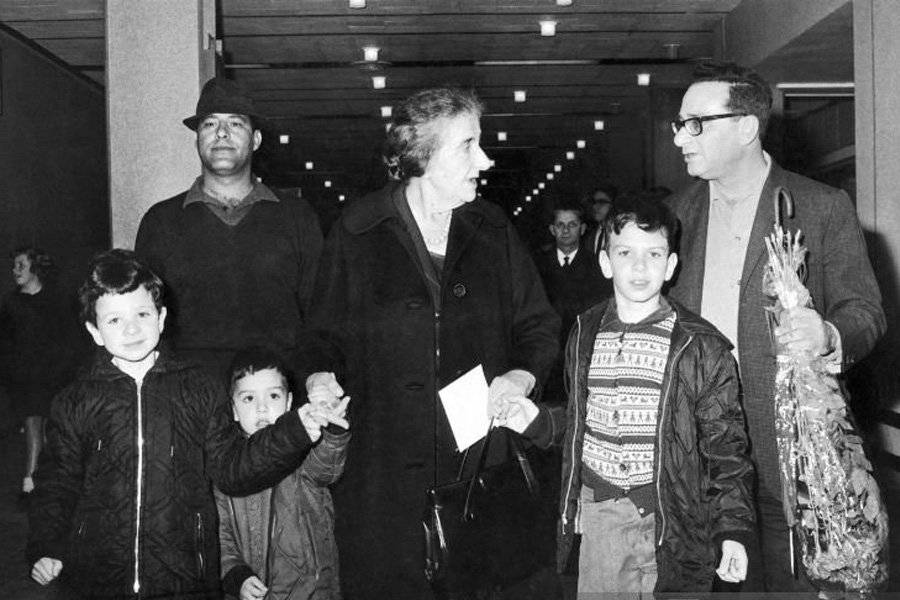
A son of a stateswoman
I have always been drawn to lives that unfold at the edge of history, where the public stage casts a bright light yet leaves room for quiet craft. Menahem Meir lived in that liminal glow. Born in Jerusalem in 1924, he entered a world already braided with upheaval, aspiration, and the steady determination that marked his mother’s path. His mother was Golda Meir, teacher turned organizer turned prime minister, a figure whose name ripples through political memory. His father, Morris Meyerson, stood as the family’s other pillar during years of movement and change. Between them, Menahem and his sister Sarah grew up inside a household that balanced idealism with daily life, policy debates with dishes in the sink, public service with private study.
A new society was forming in Menahem’s early years. Sound became his language as his mother rose in public life. The family traced back to grandparents Blume Neiditch and Moshe Yitzhak Mabovitch, whose names reflected migrations and traditions that inspire creativity. That constellation of family links helped him define identity and find a route beyond political fame.
Finding a voice through the cello
I picture him first as a student, a cello under his chin, the instrument’s grain catching light like a warm hillside at dusk. He trained at the Israel Conservatory in Tel Aviv, and then refined his studies at the Manhattan School of Music. Technique met taste; discipline met curiosity. The cello demands patience and rewards daring, and Menahem navigated that terrain with the kind of poise that feels earned rather than inherited.
His career grew in tandem with the country’s cultural institutions. He performed with Israeli orchestral ensembles, the bow arching across the strings as audiences listened for the radiance that a good cellist can summon from silence. Later he served as director of the Israel Conservatory in Tel Aviv, a role that frames artistry within education, policy within practice. Many musicians are remembered for the notes they played. Some are remembered for the halls they built, the programs they nurtured, the students who found their footing under their guidance. Menahem belonged to that second group as well as the first.
From rehearsal rooms to concert stages, from lesson plans to administrative decisions, he cultivated a life where sound is both craft and community. I suspect that balance came naturally to someone raised near the machinery of public life, where attention is a resource and stewardship a calling.
Family portraits
To understand Menahem, I like to step back and see the family portrait as a living frame. There is Golda, mother, whose presence inevitably shaped the household rhythm. There is Morris, father, whose name is often rendered Meyerson or Myerson, a reminder that transliteration carries its own biography. There is Sarah, sister, born two years after Menahem, whose life on kibbutz grounds adds texture to the family story.
Behind them stand the maternal grandparents, Blume and Moshe Yitzhak, whose early migrations and labor left footprints across the map of early twentieth century Jewish life. And to the side, the maternal aunts, Sheyna and Tzipke, figures that trace the family line with additional color and weight. Through these relations, Menahem’s biography inherits more than dates and offices. It inherits a tapestry of places, languages, work, and the long memory of a community defining itself while the world turns restlessly.
In adulthood, Menahem keeps the music close and the family equally dear. Mentions in later profiles hint at his own children, including sons studying in the United States during the 1980s. The musician’s calendar breathes with practice, yet the parent’s calendar folds around the needs of study, travel, and proximity. That kind of duality always interests me. It suggests integrity, a life tuned not just to applause but to kinship.
Between public history and private cadence
Public figures cast shadows that can be hard for their children to navigate. What strikes me about Menahem’s life is how gracefully he stayed within the region of music, a realm measured in phrasing and timbre rather than votes and policy. There are profiles and archival interviews that catch him reflecting on childhood, a son’s vantage toward a mother whose schedule could be relentless. Yet the music remains center stage. No drama beyond the usual dramas of professional artistry. No whispered scandal. Just a career built on study, performance, and service to musical education.
He died in December 2014, within the Tel Aviv orbit of his professional life. Obituaries and memorial notes mark the passing with the respect that a lifetime of practice earns. The details of exact dates vary slightly across public records, a small reminder that even lives documented by history can hold traces of human ambiguity. What feels firm is the arc: a Jerusalem birth in 1924, an adulthood guided by the cello, a commitment to the institutions that teach young musicians how to bring voice from wood and string.
Timeline highlights
I trace his story as a sequence of rooms and thresholds. Childhood in Jerusalem, where family conversations weave politics and livelihood, where a boy learns the difference between noise and tone. Formal training in Tel Aviv, under teachers who understand both the tradition of the instrument and the specifics of modern repertoire. Advanced studies in New York, a city that stretches a musician’s sense of audition and ambition. Return to Israel with a broadened toolkit, then years of performing, teaching, and guiding an institution through programs, seasons, and budgets. Occasional travel that keeps him near family studying abroad. A 1970s snapshot of reflection, speaking about early memories while the country changes around him. A late career that favors education as much as performance. The final chapter in the same cultural circle he helped sustain.
When I look at this sequence, I hear a slow movement from a classical sonata. Themes introduced, developed, recapitulated with clarity and calm. Personal milestones share the stage with institutional ones, and the long resonance of family runs under the melody like a bass line.
Names and the layered record
His name appears in multiple forms in public registries and family records. Menachem or Menahem, Meir or Meyerson. These variations have the feel of travel, of languages pulled across borders and alphabets. For me, they also suggest a musician’s flexibility, the willingness to live comfortably inside more than one spelling and more than one role. He is the son of a prime minister and the director of a conservatory. He is the cellist and the teacher. He is the figure whose biography nests neatly within the larger story of Israel, yet who steps to the front of the stage with a voice distinctly his own.
FAQ
Who was Menahem Meir in public life
He was a professional cellist and music educator who studied in Tel Aviv and New York, performed with Israeli orchestral ensembles, and later served as director of the Israel Conservatory in Tel Aviv.
How is he related to Golda Meir
He was Golda Meir’s son. Golda, born Golda Mabovitch and later known as Golda Meyerson before adopting the surname Meir, served as Israel’s fourth prime minister. Menahem’s father was Morris Meyerson.
When and where was Menahem Meir born
He was born in Jerusalem in 1924.
When did he pass away
He died in December 2014 in the Tel Aviv area. Some public records differ on the exact day, so the month and year are the most consistently verified details.
Did Menahem Meir have siblings
Yes. His sister was Sarah, born in 1926. She is often noted in family biographies and lived on a kibbutz during her adult life.
What did he study and where
He studied cello at the Israel Conservatory in Tel Aviv and continued advanced studies at the Manhattan School of Music in New York.
What roles did he hold in music education
He performed professionally and later served as director of the Israel Conservatory in Tel Aviv, contributing to curriculum, training, and the broader cultural life of the institution.
Are there notable controversies associated with him
No. His public profile centers on music performance and education. Reports and archival mentions present him in a respectful, professional light without significant controversy.
Why do records show different versions of his name
Name variations reflect transliteration differences between languages and the evolution of family surnames. You may see Menachem or Menahem for his given name, and Meir or Meyerson in connection with family history.
Did he have children
Mentions in profiles indicate that he had children, including sons who studied in the United States during the 1980s. Detailed public information about his descendants is limited, consistent with a family that kept private lives private.